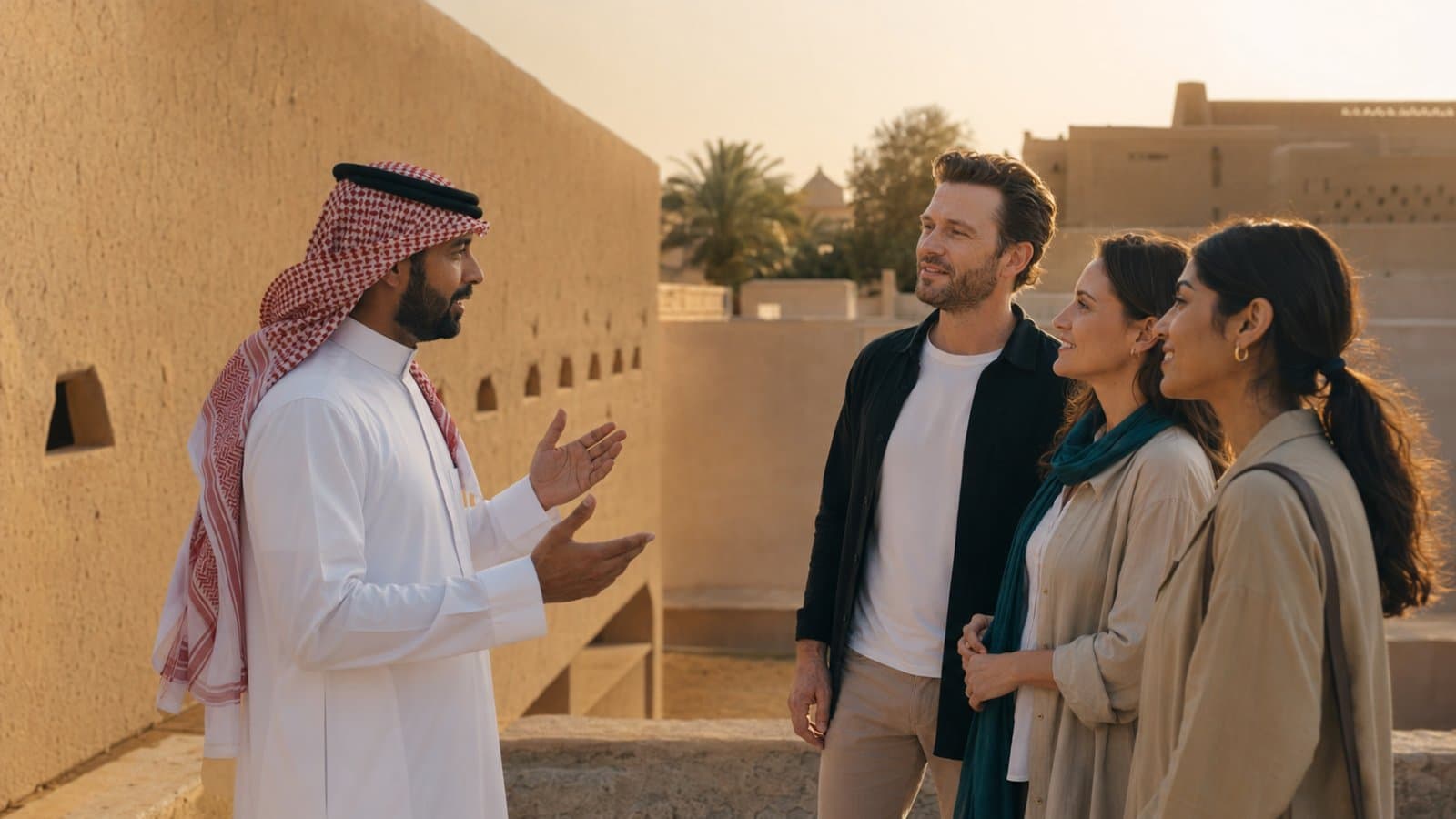
Local guides
Jeddah Local Guides
Jeddah is the city Saudi Arabia gives to the sea. For centuries it was the entry point for pilgrims arriving by ship to Makkah and Madinah, and that long history of welcoming people from every corner of the Muslim world has shaped a coastal Hijazi identity that is genuinely different from the rest of the Kingdom. Travelers who only know Riyadh or AlUla often arrive expecting another desert capital and instead find a humid Red Sea town with carved wooden balconies, an old quarter that smells of spices and oud, a long Corniche, and a food culture that pulls from Yemen, Egypt, Hadramawt, and the Indian Ocean. A good guide can help you read this layered city instead of treating it as a checklist.
Start with Al-Balad if you want to understand Jeddah at all. The historic core, listed by UNESCO in 2014, is a small district of multi-story houses built from coral stone quarried from the Red Sea reefs, faced with the carved wooden balconies known as rawasheen. The lattice work was practical — letting in sea breeze, filtering glare, and giving women private viewing space — but it also became the visual signature of Hijazi architecture. Walk Al-Balad early in the morning before the heat builds, or after sunset when the lanes reopen and shopkeepers begin trading. Many of the merchant houses, like Beit Nassif and Beit Matbouli, are now museums or being restored, and a guide who knows which doors are open on which days will save you a frustrating loop.
The Red Sea itself is the second axis of any Jeddah day. The Corniche stretches for kilometers along the coast, with public art, family parks, and seating that turns into a city-wide majlis at sunset. The Floating Mosque (Masjid Ar-Rahmah) sits on a small platform reaching into the water and is one of the most photographed buildings in the country. Further north, King Fahd's Fountain is the tallest of its kind in the world, especially striking after dark. Beyond the Corniche, the coast is the diving and beach axis: Obhur and Sharm Obhur are the gateway to Red Sea reefs that draw divers from across the region, and a guide can match you with the right operator and depth profile.
Hijazi food is its own reason to visit. The dish travelers most often hear about is sayadiyah, fish baked or steamed over spiced rice with tamarind and onions; mughalghal is the slow-cooked Hijazi spiced meat that families serve at gatherings; and breakfast is foul, tameez bread, and balaleet — a sweet-savory vermicelli with eggs that betrays the city's Indian Ocean ties. Streets like Al-Balad and the older Sharafia neighborhoods still have third- and fourth-generation kitchens worth seeking out. Newer Jeddah, around Al-Hamra and the Corniche districts, balances this with contemporary Saudi tasting menus and specialty coffee. A guide can shape a food day around what you actually want — heritage, family-run, or polished modern — instead of leaving you stranded between guidebook recommendations.
Jeddah's climate is the single biggest practical difference from Riyadh. The Red Sea coast is humid year-round. October to March is the most comfortable window, with daytime temperatures in the high twenties and a real sea breeze. April through September is hot and sticky, with heat indices that make midday walking in Al-Balad genuinely unsafe. Plan outdoor stops for early morning or after sunset in those months and let your guide build indoor or seafront alternatives — museums, the souqs that come alive in the evening, or sunset dhow trips — into the daytime gaps.
Getting around is less obvious than it sounds. Jeddah has no operational metro yet, and the city sprawls along the coast, so most movement happens by car. Uber and Careem cover the city well and are the default for most visitors. Al-Balad is genuinely walkable once you are inside it; the Corniche has long sections where walking is the right pace; almost everywhere else you will be in a vehicle. A guide with their own car solves the awkward gap between heritage walking, Corniche stops, and a dinner reservation that is twenty minutes away in traffic.
Culturally, Jeddah is the Hijazi half of Saudi Arabia. The local dialect, the dress, the music — including the brass-driven Mizmar tradition still played at weddings — and the openness to outside influence all reflect centuries of pilgrim settlement and Red Sea trade. Travelers who have only been to Riyadh sometimes find Jeddah more relaxed and more visibly diverse, which is partly real and partly the effect of a port-city culture that has always lived with arrivals. A good guide will explain when the city is showing you its Hijazi side and when it is showing you the broader Saudi present.
If you only have one day, anchor it in Al-Balad in the morning, a Hijazi lunch, and a Corniche evening with the Floating Mosque. Two or three days let you add the Red Sea axis — diving or a sunset dhow — plus deeper food exploration and one of the modern districts. Most travelers underestimate Jeddah on the way in and leave wishing they had stayed another night.
What to plan in Jeddah
Walk Al-Balad's UNESCO core early or after sunset to read coral-stone houses, rawasheen, and merchant museums on a guide-led route.
Pair the Corniche with the Floating Mosque and a sunset dhow trip to anchor the Red Sea half of any itinerary.
Build a Hijazi food day around sayadiyah, mughalghal, foul, and the older Sharafia kitchens before sliding into contemporary tasting menus.
Plan around year-round humidity — winter daytime is fine, but summer outdoor stops only work early morning or after sunset.
Use a guide with a vehicle to bridge heritage walking, Corniche stops, and dinner reservations across the city's coastal sprawl.
Top guides in Jeddah
Page 1 of 1