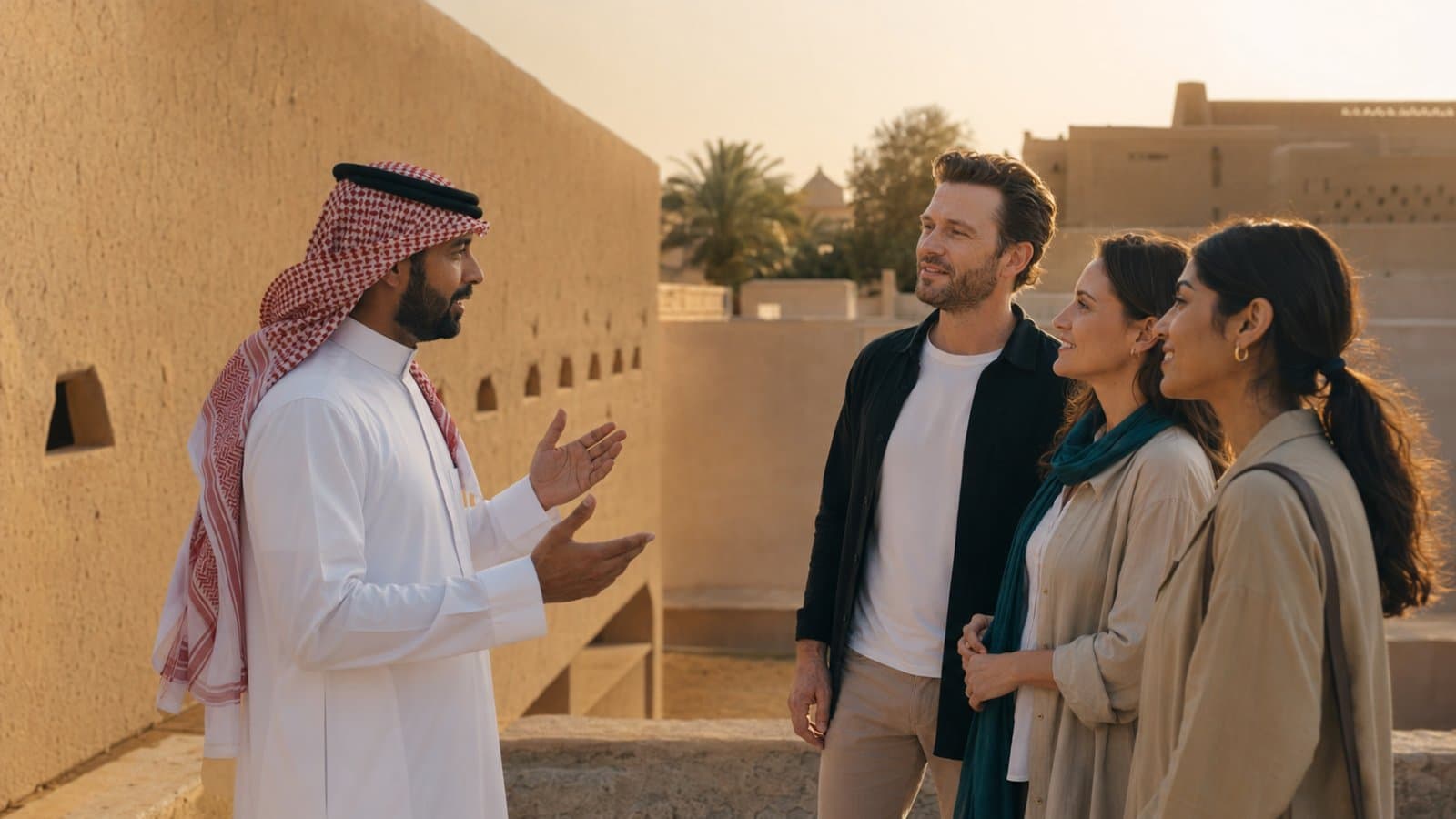
Local guides
Tabuk Local Guides
Tabuk is the gateway to a part of Saudi Arabia most travelers have not yet seen, and the part the Kingdom is investing the hardest in. The northwest region rolls from sandstone deserts down to the Red Sea coast, and within a few hours of Tabuk city you can stand among Nabataean inscriptions, walk the ruins of an Ottoman railway station, sleep in a sandstone valley that looks like it was sculpted on purpose, and approach the edge of NEOM and the Red Sea Project tourism zones. A guide here is less about translation and more about logistics — the distances are real, the routes are not always obvious, and a 4WD vehicle is sometimes the difference between a great day and a stranded one.
The Hisma Desert defines the visual identity of the region. Its sandstone formations — pillars, arches, mushroom rocks, narrow canyons — are dramatic in a way that travelers familiar with Wadi Rum in Jordan will recognize, because it is the same geological belt continuing south into Saudi Arabia. Hisma is largely empty, which is part of its appeal. Sunrise and sunset transform the rock from pale orange to deep red, and a guide who knows the dirt tracks can take you to formations that no public road reaches. Bring more water than you think you need, plan for the heat, and treat the desert with the respect any open landscape deserves.
Al-Disah Valley sits inside the broader Hisma area and is the most photographed single location in the region. A long canyon system of vertical sandstone walls opens onto a narrow oasis floor with palm groves, springs, and small patches of grass. The contrast between the desert pillars above and the cool palm shade below is the experience travelers describe most. There is a manageable path through parts of the valley, but a guide will help you read which sections are safe in heat, where the easier 4WD entries are, and where the water table makes the floor temporarily soft.
Tabuk's history sits along the railway. The Hejaz Railway, built by the Ottoman Empire in the early twentieth century to carry pilgrims and troops south toward Madinah, ran through Tabuk, and the region has the best preserved cluster of stations and rolling-stock fragments left from that line. Tabuk Castle, originally a sixteenth-century pilgrim-route fort, sits in the city itself and now functions as a small museum. World War One fought across this same railway: T.E. Lawrence and the Arab Revolt operated along the line, and a guide can frame the stations not just as ruins but as nodes of a war that shaped the modern Middle East.
Jabal Al-Lawz, the "Almond Mountain," is the regional surprise. At roughly 2,500 meters in the mountains north of Tabuk, it gets occasional snow in winter — extraordinarily rare in Saudi Arabia and a near-mythological event for domestic travelers, who drive overnight from across the country to see it. Even without snow, the mountain offers cool air, almond and juniper vegetation, and a quiet that the lower deserts cannot give you. Local sources also identify the area with biblical and Quranic geography, which adds another layer of interest for some travelers; a guide can present the historical and the mythical without confusing them.
The northwest is also Saudi Arabia's tourism megaproject zone. NEOM occupies a large part of the coastal region around the Gulf of Aqaba, and the Red Sea Project stretches further south. Sindalah, NEOM's first opened destination, is positioned as a yacht and luxury island. Most of these projects are not yet ordinary tourist destinations — access is regulated, and operating dates change — but Tabuk is the regional hub from which travel adjacent to them is becoming feasible. A guide can help you understand what is actually open, what is announced, and what fits a normal traveler versus an event guest.
Climate in Tabuk is cooler and drier than the Red Sea coast or central Arabia. Daytime temperatures are pleasant from October through April, and even summer is less oppressive than Jeddah because humidity is low and evenings cool quickly. Winters can drop close to freezing in the higher elevations, with rare snow on Jabal Al-Lawz. Plan for layered clothing and treat winter desert nights seriously: even when the day is mild, the open desert at three in the morning is genuinely cold.
Getting around the region is the practical hinge. Tabuk Regional Airport (TUU) connects to Riyadh, Jeddah, Dammam, and a few regional destinations. The city itself is easy enough by car or ride-hailing, but everything interesting outside the city — Hisma, Al-Disah, Jabal Al-Lawz, the Hejaz Railway sites — needs distance driving and often a 4WD. Rental cars exist; guided trips with their own vehicle are more common for visitors who do not want to navigate dirt tracks themselves. Plan day distances generously: a single Hisma-and-Al-Disah day can be six to ten hours of travel time including stops.
Tabuk rewards travelers who take it as an exploration rather than a checklist. One day, focused on Tabuk city plus a Hisma sunset, is the absolute minimum. Two or three days let you combine the desert canyons, a Hejaz Railway loop, and a Jabal Al-Lawz drive without rushing. Photographers, history travelers, and those drawn to open landscapes find Tabuk the most rewarding region in the country, partly because it has not yet been polished into a standard route.
What to plan in Tabuk
Anchor any Tabuk itinerary on Hisma Desert and Al-Disah Valley — guide-led 4WD routes reach formations no public road touches.
Combine Tabuk Castle with a Hejaz Railway station loop for a coherent Ottoman-and-WWI heritage day shaped by Lawrence-era history.
Time Jabal Al-Lawz for winter if you want the rare-snow possibility, or any other season for cool air and the almond-juniper landscape.
Treat NEOM and the Red Sea Project as adjacent rather than open destinations — access depends on operator schedules and event windows.
Use a guide with a 4WD for desert distances and dirt tracks; rental cars handle the city well, but not Hisma's interior.
Top guides in Tabuk
Page 1 of 1